
Buying your first camera can be overwhelming.
With so many models to choose from (Mirrorless cameras and compact point-and-shoots to rugged outdoor cameras) you might be asking: What is the best camera for beginners?
The good news is you don't have to have the most expensive camera to take great photos. Entry-level cameras today are more capable than ever, with excellent image quality, fast autofocus, intuitive controls and room to grow as your photography skills improve.
The trick is to select a camera that suits the type of photography you wish to enjoy.
Do you want to take pictures of landscapes on your trips? Want to photograph wildlife on weekend hikes? Family memories captured? Or do you just want to discover the world around you with a lightweight camera that is always ready to go?
What Defines a Good Beginner Camera?

When you’re buying your first camera, it’s easy to get caught up in megapixels or price. But the best beginner camera is one that will make you keep shooting and learning.
Here are the features to consider before you make up your mind.
Controls are friendly
A beginner camera should be fun, not frustrating, to use. New photographers can gain confidence by using intuitive menus, touchscreen controls and automatic shooting modes before moving on to manual settings.
Accurate Auto Focus
One of the fastest ways to enjoy photography is sharp images. Modern autofocus systems can recognize faces, eyes, animals and moving subjects, so beginners can focus on composition instead of worrying about missing a shot.
Image Quality
Size of sensor does matter . Especially in low light . Although great results can be achieved with APS-C and Micro Four Thirds sensors for beginners, you can also find great performance in a smaller package with premium compact cameras.
Portability
Too heavy or big a camera often gets left at home.
If you enjoy travelling, hiking or taking photos everyday, a lightweight camera is more likely to be part of your everyday routine.
Lens Choices
If you go with a mirrorless camera, you will also be able to use interchangeable lenses as your skills develop. That flexibility means you can try your hand at portraits, landscapes, wildlife, macro and more.
Best Beginner Cameras: Our Top Picks

1. Canon EOS R50
Best for: Beginners looking for an easy to use mirrorless camera for everyday photography.
Key Features
- APS-C Sensor 24.2MP
- Dual Pixel CMOS AF II 4K Movie Recording
- Vari-angle display
- Compact mirrorless design Pros
Pros
| ✔ Excellent autofocus |
| ✔ Beginner-friendly interface |
| ✔ Lightweight and portable |
| ✔ Strong photo and video performance |
Cons
| ✘ Limited native RF-S lens selection |
| ✘ Small battery compared with higher-end models |
Why We Recommend It
The Canon EOS R50 hits the sweet spot between ease of use and great performance. Auto shooting modes make it accessible to beginners, and advanced features provide plenty of room for growth. It's a camera that can grow with you as you get better, whether you're shooting family vacations, city streets or nature walks.
2. Sony ZV-E10 II
Best for: Those who are new to photography and content creation.
Key Features
- Image sensor APS C
- Advanced Real Time Auto Focus
- 4K video recording
- Touchscreen, fully articulated
- Pros Compact interchangeable-lens design
Pros
| ✔ Excellent Autofocus |
| ✔ Great video capabilities |
| ✔ Easy to learn for beginners |
| ✔ Broad selection of Sony E-mount lenses |
Cons
| ✘ Lacks a built-in electronic viewfinder |
| ✘ Little weather protection |
Why We Recommend It
The Sony ZV-E10 II is a solid option for beginners looking for one camera for photos, travel and social media content. The intuitive controls and reliable autofocus make it easy to get great results, even if it’s your first time picking up a camera.
3. Nikon Z50 II
Best for: Travel photography and shooting day-to-day.
Key Features
- APS-C CMOS™ sensor
- Fast hybrid auto-focus
- Comfortable ergonomic handle
- 4K UHD footage
- Bright electronic viewfinder
Pros
| ✔ Handle comfortably |
| ✔ Great image quality |
| ✔ Trustworthy AF |
| ✔Easy to handle |
Cons
| ✘ Limited DX lens selection compared with full-frame models |
| ✘ One Memory Card Slot |
Why We Recommend It
The Nikon Z50 II is an excellent all-rounder for beginners who want comfort and simplicity. It is also comfortable to hold for long periods of shooting and its menu system is intuitive, helping new photographers learn quickly.
4. Fujifilm X-M5
Best for: Beginners who enjoy creative photography and good colors straight out of the camera.
Key Features
- APS-C sensor type
- Film Simulation modes
- 4K Video recording Small compact mirrorless body
- Intuitive knobs controls Pros
Pros
| ✔ Beautiful color in JPEG |
| ✔ Travel-friendly weight |
| ✔ Creative shooting skills |
| ✔ Nice image quality |
Cons
| ✘ Less physical controls than higher-end Fujifilm models |
| ✘ Battery life could be improved |
Why We Recommend It
The Fujifilm X-M5 is a fun camera to use. Its Film Simulation modes encourage experimentation and creativity from day one with its ability to produce unique looks without the need for extensive editing, making it perfect for beginners.
5. OM System OM-5
Best for: Beginners in outdoor adventures and nature photography.
Key Features
- 20MP Four Thirds sensor
- In-body stabilization
- Weatherproof housing
- High-Speed Burst Mode
- Compact mirrorless design
Pros
| ✔ Lights for hiking |
| ✔ Great stabilization |
| ✔ Weatherproof construction |
| ✔ Good for landscape and wildlife |
Cons
| ✘ Smaller sensor than APS-C competition |
| ✘ Menu system is a time investment to learn |
Why We Recommend It
If your weekends are spent exploring forests, mountains or national parks, the OM System OM-5 is one of the best beginner cameras in nature photography. The weather-sealed build and effective stabilization are great for outdoor photography, even as conditions change.
6. Littpopo MicroCam X1
Best for: Beginners who love to explore nature, take close-up photos and find little details.
Key Features
- Small size
- 12MP camera resolution
- 4K video recording
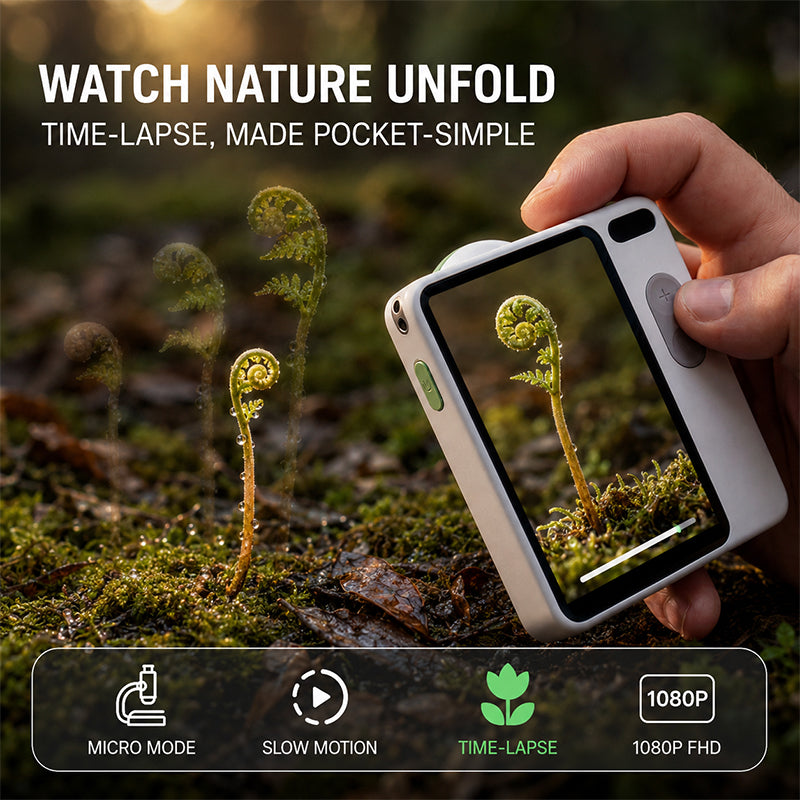
- Microscope magnification up to 400×
- Flip display for multiple shooting angles
- Live viewing via USB connectivity
- Integrated light for close subjects
Pros
| ✔ Small and light enough to bring anywhere |
| ✔ Easy to use even without advanced photography knowledge |
| ✔ Excellent for photographing everyday objects, plants, insects and textures |
| ✔ Stimulates curiosity and observation through close examination |
| ✔ Learn the basics of macro photography in a fun way |
Cons
| ✘ Not meant for long distance photography |
| ✘ Not ideal for general-purpose shooting, best for close-up subjects |
Why We Recommend It
Many beginner photographers begin by taking pictures of landscapes, people or cityscapes. But another rewarding way to learn photography is to discover the details that are often overlooked.
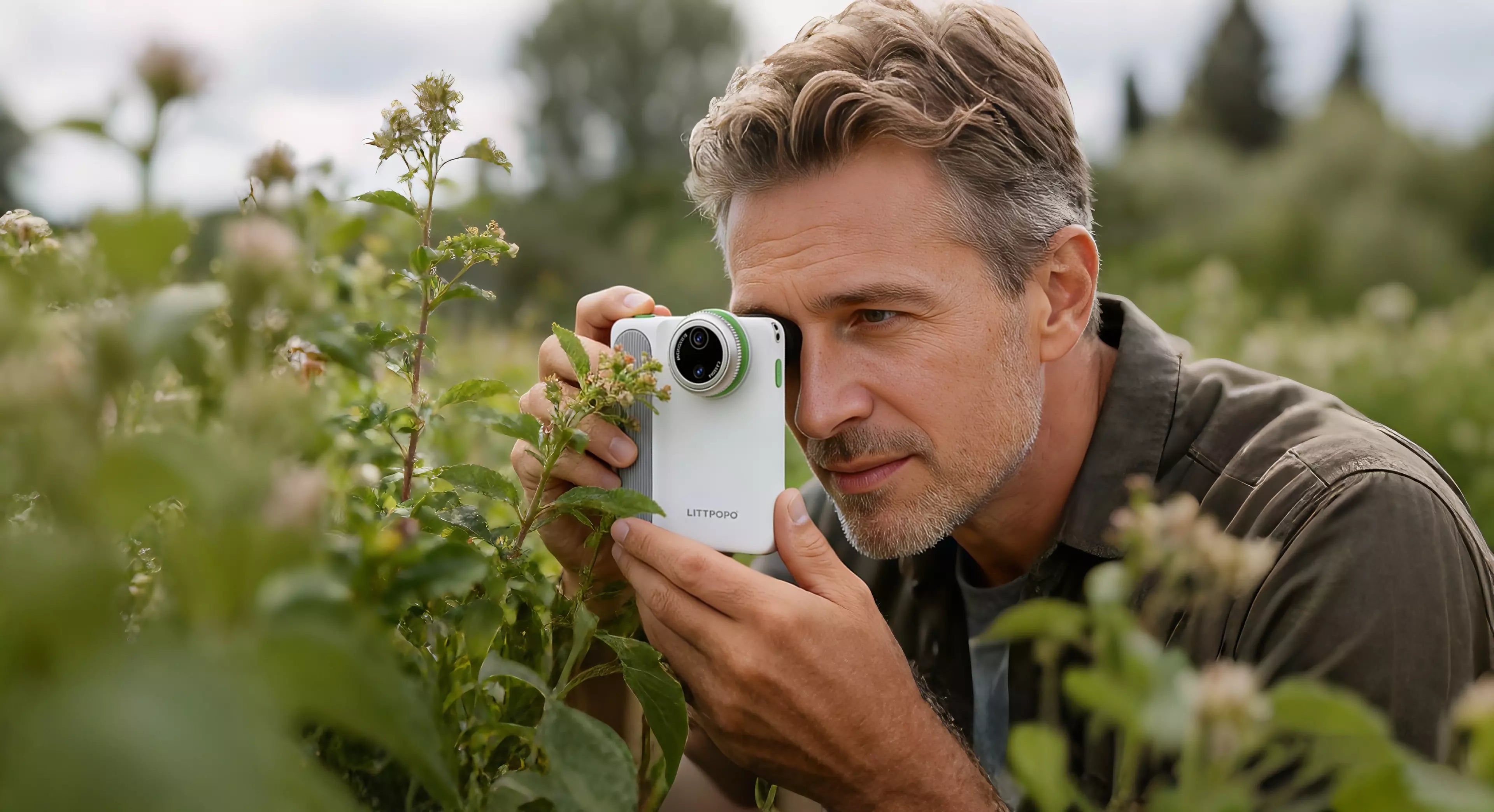
The Littpopo MicroCam X1 is an easy-to-use choice for close-up and macro photography. It is easy and fun to discover small subjects, whether it is moss on a hiking trail, the veins of a leaf, the texture of tree bark, or the intricate patterns of a butterfly wing.
Also it is easy to carry with you on walks, camping trips or vacations due to its compact size. The MicroCam X1 isn’t meant to replace a traditional camera, but to supplement it, providing a different perspective of the world that encourages novices to slow down, look closely and appreciate details they might have otherwise overlooked.
7. Ricoh GR IIIx
Best for: Everyday shooters, street photographers and travelers who want to keep things simple.
Key Features
- 24.2MP APS-C image sensor
- 40mm fixed lens equivalent
- Body Image Stabilization
- Quick start
- Budget friendly design
- Great quality RAW capture .
Pros
| ✔ Superior image quality |
| ✔ Highly portable |
| ✔ Quick and responsive |
| ✔ Perfect for everyday photography |
Cons
| ✘ Fixed focus length |
| ✘ Battery life is limited |
Why We Recommend It
The Ricoh GR IIIx is often recommended for photographers looking for a camera they can have with them at all times. Its compact body and excellent image quality are inspiring for spontaneous shooting and make it a great choice for beginners who love to document everyday life, travel and street scenes.
It doesn’t have interchangeable lenses but the simplicity allows new photographers to focus on composition, lighting and storytelling rather than swapping out gear all the time.
What is the best beginner camera for you?
Beginners have different aims so the best camera depends on what inspires you to pick it up.
| If You Want To... | Recommended Camera |
|---|---|
| Learn photography from the ground up | Canon EOS R50 |
| Create travel videos and social content | Sony ZV-E10 II |
| Photograph family trips and everyday moments | Nikon Z50 II |
| Try creative colors and film styles | Fujifilm X-M5 |
| Forests, wildlife and landscapes | OM System OM-5 |
| See the little things in nature | Littpoppo MicroCam X1 |
| Minimal setup of everyday life | Ricoh GR IIIx |
There isn’t a ‘best beginner camera’ out there. The right one is the one that fits your interests and makes you want to keep shooting.
Tips for Beginner Photographers
The camera you own is not important. Better photos come from practice, not expensive gear.Here are some simple tips for getting started:
Learn the Basics of Composition
Buying a new camera will not make as much of a difference as learning tricks like the rule of thirds, leading lines and framing.
Take Regular Shots
Best way to improve is to take your camera with you when you can. A short walk around the neighborhood can turn into a photo opportunity.
Test Different Subjects
Try landscapes, architecture, plants, wildlife, food or everyday objects. Trying out different genres helps you find out what you like best.
Auto mode: Don't be afraid of it
Automatic settings are designed for beginners. Once you build your confidence you can start to explore Aperture Priority, Shutter Priority and Manual mode.
Keep Exploring New Types of Photography
As you become more comfortable with your first camera you may find yourself drawn to other types of photography such as macro photography, wildlife or shooting after sunset.
If night photography is your next port of call, see our guide: Best Cameras & Lenses for Night Photography (2026)
In that article, we examine cameras and lenses that perform well in low light environments and provide practical tips to help you take sharp, detailed images after dark.
Final Thoughts
Picking your first camera is an exciting step towards photography.
Well the good news is that the cameras for beginners that are available today are better than they have ever been. Whether you like mirrorless cameras, compact point-and-shoot models, or specialized cameras made for outdoor exploration, there are great options for every budget and photography style.
Don’t worry about the highest specs, look for a camera that is comfortable to use and makes you want to get outside and shoot.
It’s not about having the most expensive gear, but about learning to look at the world with curiosity.
Every photo you take helps you hone your skills, refine your creative eye and build confidence behind the camera.
So pick up a camera, get outside, and start shooting the moments that are important to you.
Frequently Asked Questions
| Questions | Answers |
| What is the best camera for beginners? | No one is right. Cameras like the Canon EOS R50, Sony ZV-E10 II, Nikon Z50 II, and Fujifilm X-M5 are all fantastic beginner-friendly options, each providing a slightly different mix of portability, image quality, and ease of use. |
|
Is a mirrorless camera better than a DSLR for a beginner? |
The mirrorless cameras are better for most new photographers. They’re often lighter, have faster autofocus, and come with modern features like real-time subject tracking and electronic viewfinders. |
|
What is the best digital camera for a beginner? |
The best digital camera will depend on your interests. Some travelers prefer smaller mirrorless cameras, while some outdoor types look for weather-sealed cameras or cameras for macro photography. |
|
What's the best camera for beginner nature photographers? |
If you’re interested in landscapes and wildlife, the OM System OM-5 is a good choice due to its light weight and weather-sealed build. If you enjoy seeing small natural things, such as moss, leaves, flowers, or insects, a close-up camera such as the Littpopo MicroCam X1 offers a special way to experience nature. |
|
Do I need an expensive camera as a beginner? |
No, a lot of beginner cameras provide excellent image quality and features that are more than enough for learning photography. Spending time practicing composition, lighting, and camera settings will have a much greater impact than buying the most expensive model. |
How Much Does a Beginner Have to Spend on Their First Camera?

One of the most frequently asked questions by new photographers is:“How much should I spend on my first camera?
The answer depends on what you are trying to do, but the good news is that you don’t have to spend thousands of dollars to start learning photography.
You need to have enough room to explore, experiment and improve without putting unnecessary financial pressure on you with a beginner camera.
Here's a simple guide by budgets.
Best for Casual Photography and Learning: Under $500
Cameras in this range are a good choice if you are a beginner and want to try photography as a hobby.
At this level you can find compact cameras or entry level models that are easy to use and can produce high quality images.
These are the ideal cameras for:
- family snaps
- Travel memories.
- daily photography
- Learning basic composition.
Many of the most sensible choices for starters who aren’t sure if photography will be a long-term hobby are affordable cameras.
At this stage the most important thing is not to have advanced equipment, but to develop your ability to see interesting subjects and to capture a meaningful moment.
$500–$1000: The Best Range for Serious Beginners
That’s the sweet spot for a lot of new photographers.
Cameras in this category typically offer:
- Improved sensors
- Fast AF
- More creative control
- Interchangeable lenses.
- Better video features
Cameras like the Canon EOS R50, Sony ZV-E10 II, Nikon Z50 II and other beginner-friendly mirrorless cameras provide enough performance to last for years of learning.
This range is particularly good for someone who already knows they like photography and wants gear they can grow with.
Above $1000: For Beginners Who Want Long-Term Investment
Some beginners like to buy a camera that they can use for many years.
Higher-priced cameras often include:
- Improved low-light performance
- More sophisticated autofocus
- Better build quality
- Features professional-level
But beginners should remember that expensive equipment doesn’t necessarily mean better photos.
The price of the camera will never be as important as understanding lighting, composition, timing, story telling.
Understanding lighting, composition, timing, and storytelling will always matter more than the price of the camera.
Mirrorless vs Compact Cameras: Which Is Better for Beginners?

When looking for the best beginner camera, many new photographers have another decision to make:
Mirrorless vs. compact camera?
Each choice has its own benefits.
Mirrorless Cameras for Beginners
Mirrorless cameras are popular because they're versatile and expandable.
Advantages:
| ✔ Interchangeable lenses |
| ✔ Larger sensors |
| ✔ Better control over settings |
| ✔ Suitable for many photography styles |
| ✔ Can grow with your skills |
“A beginner with a mirrorless camera can begin with auto modes and learn advanced photography techniques as they go along.”
They are ideal for:
- Portrait photography
- Landscape photography
- Wildlife
- Travel photography
- Creative photography
Examples include:
- Canon EOS R50
- Sony ZV-E10 II
- Nikon Z50 II
- Fujifilm X-M5
Compact Cameras for Beginners
Compact cameras are all about ease and portability.
They’re for people who want a camera that is easy to carry and ready when inspiration strikes.
Advantages:
| ✔ Lightweight |
| ✔ Easy to use |
| ✔ No need to change lenses |
| ✔ Great for travel |
| ✔ Less intimidating for beginners |
Compact cameras are ideal for:
- Everyday photography
- Street photography
- Travel
- Outdoor exploration
Specialty compact cameras can also provide unique photography experiences for novices.
For instance, the Littpopo MicroCam X1 lets beginners try out macro and microscope photography without having to deal with complex equipment. “Beginners can find details in plants, insects, textures and everyday objects, rather than just photographing large scenes.
Best Beginner Camera for Travel Photography
It’s usually about something light, reliable and versatile for travel photographers.
Important features:
- Small in size
- Long Battery Life
- Rapid autofocus
- Good quality photos
Popular choices include the Sony RX100 series, Canon EOS R50, and Fujifilm models.
Best Camera for Beginners in Nature Photography
Nature photography is patience, and observation.
For the beginner interested in forests, plants, landscapes and wildlife, consider:
- Weather-proof
- Lightweight design
- Good Autofocus
- Macro capabilities
The OM System OM-5 is a great choice for outdoor photography, while the Littpopo MicroCam X1 is a different approach that lets beginners explore the hidden details of nature.
A simple walk in the woods can turn into a photography adventure when you start noticing:
- Leaf textures
- Moss patterns
- Flower structures
- Insect details
- Natural surfaces
Best Beginner Camera for Learning Photography
If your primary goal is to learn the basic principles of photography, get a camera that makes you want to play.
Things to look for:
- Manual operation
- Various shooting modes
- Good ergonomics.
- Lens flexibility
A camera should make you want to practice.
The more you use it, the faster you will improve your photography skills.
Final Advice: Choose the Camera That Makes You Want to Create
When people search for:
- "what is the best camera for beginners"
- "best beginner camera"
- "best cameras for beginners"
they often expect one simple answer,But photography is intimate.
The best camera is not always the one with the most specs. It’s the one that speaks to your curiosity, that pushes you to keep exploring.
A hiking-loving beginner might need something different than a street-photography-loving one.
If you love to make videos, your choice may be different than if you love to photograph nature.
The ideal first camera is one that makes you want to pick it up, step outside, and shoot something new.
Photography begins with curiosity, not expensive equipment.