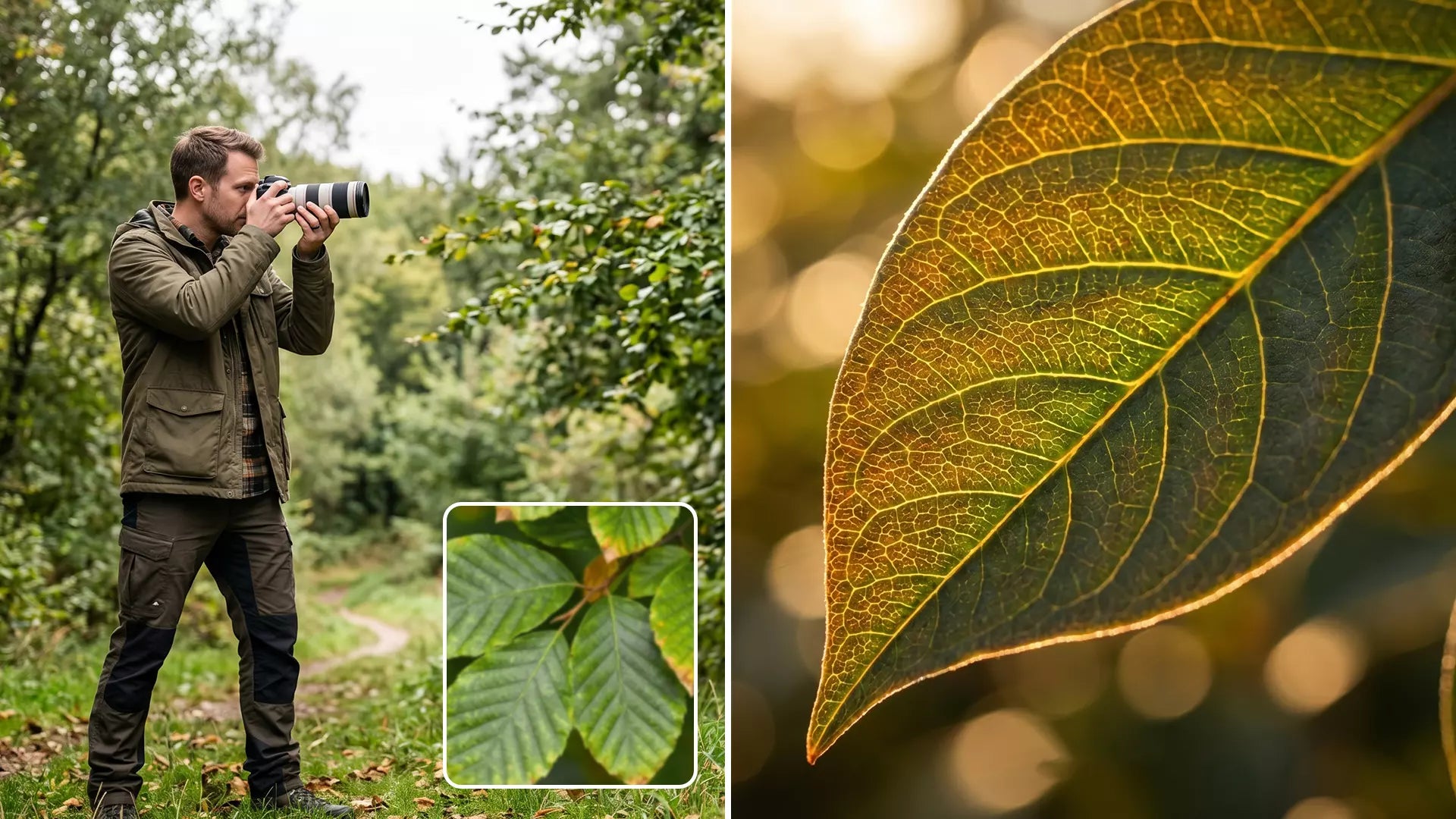
Why do leaf veins appear flat to the naked eye?

What limits human vision when observing plant details?
Human vision is optimized for larger shapes and contrast, not fine biological structures. When you look at a leaf from a normal distance, the surface appears smooth because:
- Vein thickness is too small to distinguish clearly
- Color differences between veins and leaf tissue are subtle
- Surface textures blend into a uniform green layer
As a result, most leaves look flat, even though they contain complex internal networks.
Why do leaves look different outdoors compared to close-up views?
Outdoor viewing conditions introduce variables that reduce visible detail:
- Bright sunlight can flatten contrast
- Wind causes slight movement, reducing clarity
- Distance prevents focus on micro structures
Even when details are present, they are not easily isolated without magnification.
How does a microscope camera reveal leaf vein structures?
What changes when you view a leaf at micro scale?
At close range, a microscope camera reveals:
- Primary and secondary vein branching
- Fine capillary-like structures between veins
- Junction points where veins split or merge
Instead of a flat surface, the leaf becomes a layered structure with visible pathways that transport water and nutrients.
Why do vein patterns appear more contrasted under magnification?
Magnification does not just enlarge the image—it changes how light interacts with the surface.
Under a microscope camera:
- Raised veins cast micro-shadows
- Thin leaf tissue allows light to pass through unevenly
- Surface textures create contrast variations
This makes vein networks appear sharper and more defined, even without artificial lighting.
How does natural outdoor light affect what you see?

Why do leaf veins look clearer in certain lighting conditions?
Natural light plays a critical role in revealing plant detail.
Best conditions include:
- Early morning light, when leaves may have moisture
- Side lighting, which enhances texture through shadow
- Soft, diffused light under trees or clouds
These conditions highlight vein structure without washing out detail.
Does moisture or environment change how veins appear?
Yes. Outdoor environments often enhance visibility.
For example:
- Dew increases contrast by outlining veins
- Dust or pollen can settle along vein lines
- Slight leaf damage can expose internal structure
These natural variations make outdoor observation more informative than controlled indoor viewing.
How can you observe leaf veins outdoors step by step?

What is the simplest way to start observing leaf veins?
You don’t need a complex setup. A practical approach includes:
- Find a stable leaf
- Attached leaves on low branches work best
- Avoid leaves that move easily in the wind
- Position close to the surface
- Bring the camera near the leaf
- Keep a steady distance for consistent focus
- Use natural light
- Adjust your angle rather than adding artificial light
- Look for side lighting to enhance detail
- Capture multiple views
- Focus on different parts of the leaf
- Compare edges, center veins, and damaged areas
Devices like MicroCAM X1 are designed for this kind of close-range outdoor observation, allowing stable focus and detailed capture without needing additional equipment.
Where are the best places to observe leaf vein details?

You can find suitable subjects almost anywhere outdoors:
- Parks: Leaves near walking paths are easy to access
- Gardens: Healthy plants show clearer vein structures
- Hiking trails: Wild plants often display more variation and texture
Look for:
- Broad leaves with visible structure
- Leaves with slight wear or insect interaction
- Moist environments where detail is enhanced
What mistakes do beginners make when observing leaf veins?

Do beginners try to capture too much at once?
Yes. A common mistake is photographing the entire leaf instead of focusing on a small section.
Better results come from:
- Zooming into one vein junction
- Observing a small textured area
- Capturing detail rather than composition
Is lighting often misunderstood?
Many beginners rely on bright light, which reduces detail.
Instead:
- Avoid direct overhead sunlight
- Use angled or diffused light
- Adjust position rather than increasing brightness
Does camera movement affect detail?
Even slight movement can blur micro details.
Common issues include:
- Hand movement
- Wind affecting the leaf
- Changing distance too quickly
Stability is more important than speed when working at this scale.
Who benefits most from understanding leaf vein detail?

Is this useful for nature photography?
Yes. Understanding leaf structure improves:
- Subject selection
- Composition in both macro and wide shots
- Awareness of natural patterns
Is this relevant for learning and exploration?
Leaf vein observation helps explain:
- How plants transport nutrients
- How structure relates to function
- How environmental factors affect growth
This makes it useful for both casual exploration and educational purposes.
Is this accessible for beginners?
Yes. Observing leaf veins outdoors does not require advanced skills.
With a simple approach and a tool designed for close observation, such as MicroCAM X1, beginners can start seeing meaningful detail almost immediately.
Final takeaway
Leaf veins appear different under a microscope camera because magnification reveals structure, light interaction, and surface detail that are otherwise invisible. In outdoor environments, natural light and environmental conditions further enhance these features, making everyday plants a rich subject for detailed observation and photography.