
A good time-lapse can make hours, days, or even months of change visible in just a few minutes.
A construction site goes from an empty lot to a finished building. A flower opens almost impossibly fast. Clouds sweep across a landscape. Guests arrive at an event and suddenly the room is full.
The basic idea is simple: capture individual frames at set intervals, then play them back as a video. The difficult part is choosing the right camera for the job.
A camera that's perfect for a weekend event may be completely unsuitable for a six-month construction project. Likewise, a camera designed to sit outside for months isn't necessarily the best choice for shooting a creative nature sequence.
So what is the best time lapse camera in 2026?
There isn't one answer. The right choice depends mainly on how long you need to record, where the camera will be installed, how much control you want, and whether you need a finished time-lapse video straight from the camera.
What Makes a Good Time Lapse Camera?
 Before looking at specific cameras, there are a few things that matter more for time-lapse photography than they do for normal shooting.
Battery Life
This is probably the first specification to check for long-term projects.
If you're recording a construction site for several months, changing batteries every few days simply isn't practical. Dedicated time-lapse cameras can run for weeks or months on batteries, while some professional systems can also use solar power.
For shorter projects, battery life is less important. A camera that lasts a few hours may be perfectly adequate for an event or a sunset.
Interval Settings
The interval determines how frequently the camera captures a frame.
A flower opening might require an image every few seconds or minutes. A construction project might only need one frame every 5–15 minutes.
A good time lapse camera should give you enough control to choose the interval that matches the speed of the subject.
Weather Protection
Outdoor time-lapse photography introduces a problem that normal photography doesn't: your camera may have to survive weather for days or months without anyone touching it.
Rain, dust, condensation, heat and cold can all become serious issues.
For long-term outdoor projects, a weather-resistant housing or purpose-built enclosure is much more important than simply having a high video resolution.
Remote Access
For cameras installed somewhere difficult to reach, remote monitoring can be extremely useful.
Some newer systems offer Wi-Fi, cellular or cloud-based access, allowing you to check the camera without physically visiting the installation site.
That feature is particularly valuable for construction companies managing multiple projects.
1. Brinno TLC2020 — Best Time Lapse Camera for Most People
If you specifically want a dedicated time lapse camera, the Brinno TLC2020 is one of the strongest all-around choices.
TechRadar currently ranks it as its best overall time-lapse camera, highlighting its combination of ease of use, battery life, mounting options and versatility. The camera records at 1080p and can run for up to around 99 days at a five-minute interval, depending on conditions.
That makes it particularly attractive for projects that last much longer than a normal camera battery would allow.
The TLC2020 is also relatively compact and can be paired with weatherproof accessories, making it suitable for outdoor installations.
The biggest limitation is resolution. If you're producing a large commercial video where 4K output is important, a newer 4K system may make more sense.
But for most people who simply want a reliable camera that can sit in one place and record a project over an extended period, the TLC2020 is a sensible choice.
Best for: construction progress, DIY projects, outdoor monitoring and long-term time-lapse photography.
Watch out for: 1080p resolution and the relatively limited close-focusing capability with its standard lens.
2. Enlaps Tikee 4 — Best Professional Time Lapse Camera
For professional projects, the Enlaps Tikee 4 takes a very different approach.
It is designed for long-term outdoor monitoring and uses a panoramic setup that provides an extremely wide field of view. TechRadar lists it as its premium choice, with a 220-degree field of view and a design aimed at professional time-lapse applications.
That wide perspective is especially useful for large construction sites or infrastructure projects where you want to capture a substantial area without installing several conventional cameras.
The downside is cost.
A professional time-lapse system is difficult to justify for a hobbyist who simply wants to record a garden or a short event. There can also be ongoing software or subscription costs depending on how you use the system.
Best for: large construction projects, infrastructure, commercial monitoring and professional productions.
Avoid if: you're only planning short or occasional time-lapse projects.

3. Brinno BCC5000 — Best 4K Construction Time Lapse Camera
Construction sites create some of the toughest conditions for a time lapse camera.
The camera may need to stay outside for months, survive dust and rain, operate without a convenient power source, and produce footage good enough for project documentation or marketing.
The Brinno BCC5000 is specifically designed around those requirements.
It combines a 4K camera with a weather-resistant enclosure and long-term recording capabilities. Brinno's current 2026 construction range positions the BCC5000 as its premium solution for large-scale and remote projects, with Wi-Fi, Bluetooth and remote management features.
Its Sony STARVIS 2 sensor is another useful feature for construction environments where lighting can change significantly throughout the day.
This is not a camera I'd recommend simply because it records in 4K. Its real value comes from the combination of 4K image quality, long-term operation, weather protection and remote management.
Best for: commercial construction, infrastructure projects and long-term outdoor recording.
Watch out for: the price. It's designed for professional projects, not casual time-lapse photography.
4. Brinno TLC300 — Best Simple Time Lapse Camera
Not every project needs 4K, cloud management or a professional monitoring platform.
Sometimes you just want to put a camera somewhere, choose an interval and let it work.
That's where the Brinno TLC300 makes sense.
It is designed as a simpler dedicated time-lapse camera and uses four AA batteries. Brinno currently positions it for general-purpose recording and smaller projects, with up to around 100 days of battery life depending on the shooting interval and conditions.
The advantage is straightforward operation.
You don't need to build a complicated camera system just to record a renovation, garden project or small construction job.
Its 1080p output isn't impressive compared with modern mirrorless cameras, but for documentation and online video it can be perfectly adequate.
Best for: beginners, small construction projects, DIY projects and straightforward long-term recording.
5. GoPro HERO13 Black — Best Action Camera for Time Lapse
If your time-lapse project involves movement, travel or changing locations, a dedicated construction camera isn't necessarily the best choice.
A GoPro HERO13 Black gives you something very different: a rugged, compact camera that can shoot time-lapse sequences while also functioning as a normal action camera.
That makes it especially useful for hiking, cycling, travel and outdoor events.
You can also use it for shorter static time-lapse sequences such as clouds moving across a landscape or a sunset.
The main limitation is battery life. A GoPro isn't designed to sit unattended for months in the way a dedicated construction time-lapse camera is.
So think of it as a flexible short-term time-lapse camera, rather than a replacement for a dedicated long-term system.
Best for: travel, outdoor events, hiking, cycling and short projects.
6. aTLi EON — Best Budget Time Lapse Camera
If you're looking for one of the best budget time lapse cameras, the aTLi EON is worth considering.
TechRadar currently places it in its budget category, describing it as an affordable way to create time-lapse footage without investing in a professional dedicated system.
This is an important category because not everyone needs a camera that can record for six months.
If you're experimenting with time-lapse photography, recording a small DIY project, or creating occasional sequences for social media, spending hundreds or thousands of dollars on a professional system doesn't make much sense.
The trade-off is that you shouldn't expect the same level of weather protection, battery endurance or professional monitoring features found in dedicated construction systems.
Best for: beginners, hobbyists and shorter projects where budget matters.
7. Brinno BCC2000 Plus — Best for Long Construction Projects
The BCC2000 Plus is designed for a very specific problem: keeping a camera running for a long time on a construction site.
Brinno's current comparison guide positions it as a professional solution for medium and large projects, with support for solar power and computer-based management.
That makes it particularly interesting if your construction project will continue for many months and physically visiting the camera to replace batteries would be inconvenient.
It doesn't offer the same 4K resolution as the BCC5000, but that's not necessarily a deal-breaker.
For construction documentation, reliability and uptime can matter more than maximum resolution.
If your client primarily needs a clear record of project progress, a dependable 1080p system that records continuously may be more useful than a 4K camera that requires frequent maintenance.
Best for: medium-to-long construction projects and installations where battery management is a major concern.

8. DJI Osmo Action 5 Pro — Best Compact Time Lapse Camera for Travel
A travel time-lapse setup has very different requirements from a construction site.
You want something small, rugged and easy to carry. You may also want to switch between normal video, photos and time-lapse without carrying another camera.
The DJI Osmo Action 5 Pro fits that role well.
It's primarily an action camera rather than a dedicated time-lapse camera, but that flexibility is exactly why it can be useful for travelers.
Use it for a sunrise, pack it away, then take it back out for hiking footage later.
Its compact body also makes mounting it in unusual locations easier than using a larger camera system.
Best for: travel, hiking, outdoor events and creators who want one camera to handle several jobs.
9. Insta360 X5 — Best for Creative Time Lapse
A 360 camera opens up another possibility: capturing the entire environment rather than committing to a single frame.
The Insta360 X5 can be useful for creative time-lapse sequences where you want to decide on the framing later.
For example, you could record a busy outdoor event and later choose whether the final video focuses on the crowd, the venue or your own position within the scene.
That's difficult to achieve with a conventional fixed-angle camera.
The compromise is workflow. 360 footage requires more processing and reframing, so it isn't the simplest choice for someone who just wants to press record and generate a conventional time-lapse.
Best for: events, travel, creative projects and unusual perspectives.
10. A Mirrorless Camera — Best for Maximum Image Quality
Sometimes the best time lapse camera isn't a dedicated time-lapse camera at all.
A mirrorless camera gives you access to larger sensors, interchangeable lenses and much greater control over exposure and composition.
That matters when image quality is the priority.
For example, if you're creating a cinematic sequence of a landscape changing from day to night, a mirrorless camera with a suitable lens can produce considerably more control over depth of field, exposure and dynamic range than a small dedicated time-lapse camera.
The downside is obvious: power and complexity.
A mirrorless camera consumes considerably more power, and long-duration projects may require an external power supply, intervalometer or other accessories.
For a professional short-form production, that's manageable. For a six-month construction project, it quickly becomes inconvenient.
Best for: photographers, filmmakers and controlled productions where image quality matters more than unattended operation.
How to Choose the Best Time Lapse Camera
 The easiest way to choose is to start with the project rather than the camera.
For Construction Projects
Look for:
- Long battery life
- Weather and dust protection
- Reliable interval shooting
- Remote monitoring if the site is difficult to access
- High enough resolution for the final deliverable
A dedicated camera such as the Brinno BCC5000, BCC2000 Plus or TLC2020 generally makes more sense than a conventional action camera for projects lasting months.
For Events
Events usually require a different balance.
You probably don't need months of battery life, but you'll want good image quality, easy setup and enough battery capacity to cover the entire event.
A GoPro or 360 camera can be particularly useful if you want something compact and flexible.
For Nature
Nature time-lapse photography is where things become more interesting.
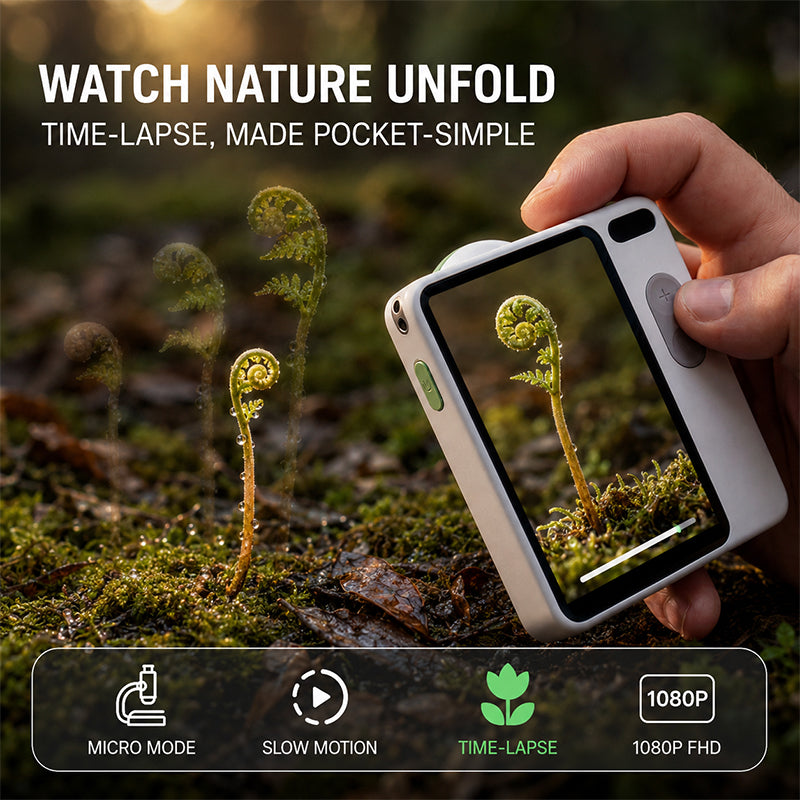
A sunrise may take only an hour or two. A flower opening can happen over several hours. A seasonal landscape might require weeks of recording.
For short nature sequences, a conventional camera or action camera can work very well.
For delicate subjects, however, focus distance and lens choice become important. A camera designed primarily for wide outdoor scenes may not be ideal for capturing tiny changes in plants or insects.
If you're interested in learning the process of creating a nature sequence, understanding how to shoot time-lapse videos can help you think about interval settings, framing and subject movement before you start recording.
How Long Should a Time Lapse Be?
The answer depends on how quickly the subject changes.
For fast-moving subjects such as clouds or people, shorter intervals can create smoother movement.
For slower subjects such as construction or plant growth, longer intervals make more sense.
A simple way to think about it is:
Final video duration = number of frames ÷ playback frame rate
At 30 frames per second, 900 captured frames would produce about 30 seconds of final footage.
That means the recording interval becomes important. If you capture one frame every 5 minutes, 900 frames represent 75 hours of real time.
For a construction project, that same principle can compress weeks or months into a short sequence.
The key is to choose the interval based on how quickly something changes, not simply choose the shortest interval available.
Dedicated Time Lapse Camera vs. Action Camera
This is probably the most important buying decision.
A dedicated time lapse camera is better when the camera needs to stay in one place for a long time. Long battery life, weather protection and simple interval shooting are its strengths.
An action camera is better when you want flexibility. You can use it for normal video, photos, time-lapse and travel footage, then pack it away when you're finished.
Neither is universally better.
For a six-month construction project, I'd take the dedicated system.
For a weekend hiking trip, I'd rather carry the action camera.
For a cinematic nature sequence where image quality matters most, I'd consider a mirrorless camera.
Final Verdict
The best time lapse camera depends heavily on what you're trying to compress into a few minutes.
For most dedicated time-lapse users, the Brinno TLC2020 offers a strong balance of simplicity, battery life and flexibility. For professional construction and infrastructure projects, the Enlaps Tikee 4 and Brinno BCC5000 offer capabilities that consumer cameras simply aren't designed to provide.
If budget matters, the aTLi EON provides a more accessible starting point. And if you're traveling or shooting short outdoor sequences, a GoPro HERO13 Black or DJI Osmo Action 5 Pro may actually be more useful because you can use them for far more than time-lapse.
The most important thing is not to buy based on resolution alone.
Think about how long you need to record, where the camera will live, how often you can access it, and how quickly your subject changes.
Once you answer those four questions, choosing the right time lapse camera becomes much easier.