

Most houseplant pests are easy to miss until the damage is already there. Spider mites, thrips, mealybugs, scale, aphids, whiteflies and fungus gnats can all hide in places you don't normally look, while springtails may show up in the soil without actually harming your plant.
That's why plant pests identification often starts with a symptom rather than the name of an insect.
You notice tiny white bugs on a leaf. There are silver streaks where the surface used to be green. A plant suddenly has sticky leaves. Or little black flies keep appearing around the pot.
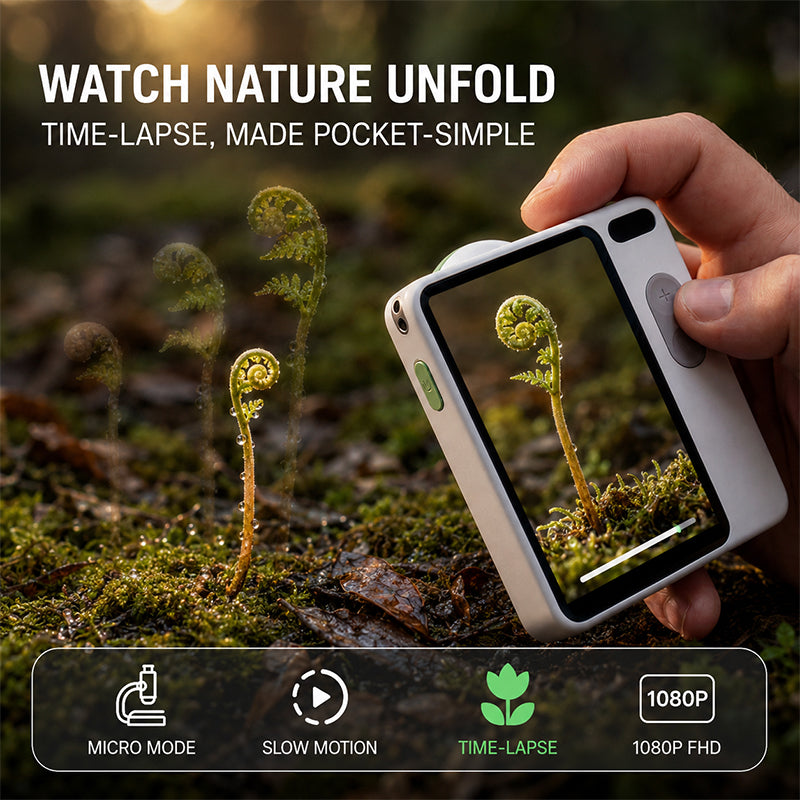
Those clues can narrow things down, but some houseplant pests are so small that looking with the naked eye isn't enough. A magnifying glass can help, and a MicrocamX1 makes it much easier to see the body shape, legs, eggs and other details that separate one pest from another.
Here are eight common indoor plant pests—and what they actually look like up close.
- Spider mites — tiny yellow-orange mites, often with dark spots and fine webbing
- Thrips — slender insects that leave silvery feeding scars and dark specks
- Mealybugs — white, cottony-looking insects hiding around stems and leaf joints
- Scale — small bumps that can look like part of the plant itself
- Aphids — soft-bodied insects that often cluster around young growth
- Whiteflies — tiny white flying insects that scatter when a plant is disturbed
- Fungus gnats — small dark flies associated with damp potting soil
- Springtails — tiny soil-dwelling creatures that jump when disturbed and are usually harmless
The interesting part starts when you stop looking at the whole plant and start looking at the individual pest.
Quick ID Chart: What You See → What It Probably Is
 Before reaching for a treatment, look at where the problem appears and what the damage actually looks like.
| What you see | Where to look | Likely pest | What to check under magnification |
|---|---|---|---|
| Fine webbing and tiny yellow or white specks | Leaf undersides, stems | Spider mites | Tiny eight-legged bodies and round eggs |
| Silvery streaks with black specks | Leaf surfaces and new growth | Thrips | Slender, cigar-shaped insects |
| White cotton-like material | Leaf axils, stems, roots | Mealybugs | Segmented body with waxy filaments |
| Brown or tan bumps that don't seem to move | Stems and leaf veins | Scale | Dome-like body attached to the plant |
| Sticky, shiny leaves | Leaves and surfaces underneath | Aphids, scale or mealybugs | Look for the insects producing honeydew |
| Tiny white flies that scatter | Leaf undersides | Whiteflies | Powdery wings and scale-like nymphs |
| Small black flies around the pot | Soil surface | Fungus gnats | Larvae in the soil, often with dark heads |
| Tiny pale or white specks that jump | Soil and drainage areas | Springtails | Rounded or elongated bodies that spring away |
| White spots that wipe off and show no movement | Leaf surface | Mineral residue or mildew | No legs, body or insect structure |
This isn't a substitute for a proper diagnosis, but it gives you somewhere to start.
One useful rule is to check the underside of the leaves first. Many houseplant insects and mites spend most of their time there, where they're protected from direct light and harder to notice.
Not sure what you're seeing? Don't immediately spray the plant. Grab a magnifier and take a closer look first.
How to Inspect a Plant for Pests: A 5-Minute Check
You don't need a complicated setup to inspect a houseplant.
In fact, five minutes of careful observation every week can tell you much more than waiting until an infestation becomes obvious.
1. Start with the undersides of the leaves
Turn the leaves over gently.
This is one of the first places to check for spider mites, thrips, whiteflies, aphids and other pests. Look for insects, eggs, webbing, discoloration and tiny feeding marks.
Spider mite damage, for example, can appear as tiny pale or yellow spots across the leaf before the mites themselves become obvious.
2. Check new growth and leaf joints
Look closely at the places where leaves meet stems.
Soft-bodied pests often gather around young growth, while mealybugs are particularly fond of protected spaces such as leaf axils.
If you see something white and fuzzy, don't assume it's mold. Move closer.
A cottony appearance can be the waxy covering of a mealybug colony.
3. Try the white-paper test
For very small moving pests, hold a sheet of white paper beneath a suspicious leaf and gently tap the leaf.
Tiny mites may fall onto the paper and become much easier to see against the white background. The University of Minnesota Extension's guide to indoor plant insects recommends using this method to check for spider mites.
This is one of those simple tricks that costs nothing and can save you from guessing.
4. Check the soil and drainage holes
Not every plant pest lives on the leaves.
Fungus gnats and springtails are much more likely to be noticed around damp potting soil. Check the surface of the soil, the rim of the pot and the drainage area.
If tiny insects appear when you water, that's useful information. UMN notes that watering can cause some soil-dwelling insects, including springtails and fungus gnats, to move and become easier to detect.
5. Magnify anything suspicious
This is where a close-up inspection becomes much more useful.
At normal viewing distance, a spider mite can look like dust. A scale insect can look like a bump on the stem. A thrips can look like a tiny dark line.
Under magnification, those descriptions become much more specific.
You can see legs, body shape, movement, eggs and surface texture—details that make identification considerably easier.
The 8 Most Common Houseplant Pests: Up Close

Spider Mites
If you're trying to identify a pest from a close-up photograph, spider mites are one of the most interesting—and one of the easiest to miss.
Two-spotted spider mites are extremely small, around 1/50 inch long. They are yellow-orange and commonly have two dark spots on the body. They are actually arachnids rather than insects, which means adults have eight legs.
To the naked eye, you may notice the damage before you notice the mites.
Leaves can develop a fine pattern of tiny pale or yellow spots, sometimes described as stippling. As an infestation becomes heavier, fine webbing may appear over leaves and stems.
This is where what do spider mites look like becomes a much more useful question than simply searching for “spider mites.”
Under magnification, the body is easier to distinguish from dust or soil particles. You may also spot their round eggs clustered near feeding areas.
Spider mites often favor warm, dry conditions, and they commonly hide on the undersides of leaves.
Signs to look for:
- Fine yellow or pale stippling
- Tiny moving dots
- Fine webbing
- Leaves becoming bronzed or bleached
- Damage concentrated on leaf undersides
If you find them early, physically washing the plant can help remove mites and webbing. Insecticidal soaps and horticultural oils are also commonly used, but always follow the product label and make sure the product is appropriate for your plant.
Thrips
Thrips are much easier to recognize once you've seen one up close.
They're slender, elongated insects—almost like tiny moving slivers. They can range from yellowish to brown or black and have narrow wings folded over their backs when resting.
The damage is often easier to notice than the insect itself.
Thrips feed on plant tissue and can leave silvery or pale streaks across leaves. Tiny black specks may also appear around damaged areas.
That combination is worth remembering:
Spider mites → stippled dots and webbing.
Thrips → silvery feeding damage and dark specks.
A close-up photograph of the insect makes the distinction even clearer. Instead of a vague “tiny black bug,” you can see the long, narrow body.
Thrips can reduce plant vigor when infestations become established, so early detection matters.
Check young leaves, flowers and other areas with fresh growth, and don't rely on a single visual clue. Feeding damage can vary between plants.
Mealybugs
Mealybugs are probably the easiest pest to recognize once you know what you're looking for.
They often look like little pieces of white cotton stuck to a plant.
The problem is that they like hiding in exactly the places that are difficult to inspect: where a leaf joins the stem, around nodes, and in other protected gaps.
According to the University of Maryland Extension's guide to mealybugs on indoor plants, mealybugs are covered in powdery wax and can produce honeydew that leaves sticky residue on plant surfaces.
Under magnification, the white “fluff” starts to make more sense. You're looking at an insect with a segmented body surrounded by waxy material.
Don't just check the most visible leaves. If you find one mealybug, inspect the entire plant.
Also check around the pot and nearby plant equipment. Established infestations can spread beyond the obvious parts of the plant.
Root mealybugs are another reason a plant can seem mysteriously unhealthy even when the leaves look relatively clean. If the above-ground inspection doesn't explain the problem, the roots may deserve a closer look.
Scale
Scale insects are masters of disguise.
The first time you see them, you might not think you're looking at insects at all. Small brown, tan or gray bumps can look like part of the stem.
That's what makes scale particularly interesting for close-up identification.
Instead of looking for something that obviously moves, look for repeated bumps attached along stems, leaf veins or other plant surfaces.
Scale insects can be divided into different groups, including soft scale and armored scale, and their appearance varies. Some are relatively flat while others have a more dome-like shape.
Honeydew is another clue, particularly with soft scale. If the leaves are unusually sticky and you can find bumps attached to the stems, scale becomes a possibility.
A MicrocamX1 is useful here because it lets you inspect the surface without immediately disturbing the insect.
And if you gently dislodge a suspected scale insect, looking at what was underneath can help confirm that it isn't simply a natural feature of the plant.
Aphids
Aphids are small, soft-bodied insects that often appear in groups.
They're particularly common around tender new growth, stems and other areas where the plant is actively growing.
Depending on the species, aphids can be green, black, yellow, brown or other colors, so color alone isn't enough for identification.
Look instead for a cluster of small, pear-shaped insects.
Aphids can produce honeydew, which leaves a shiny, sticky residue on leaves and nearby surfaces. That's one reason sticky leaves on plants can be an important clue when diagnosing an infestation.
Under magnification, their body shape becomes much easier to distinguish.
If you see several small insects clustered around new growth, zoom in before deciding what you're dealing with. A close-up can also reveal whether you're looking at aphids or another soft-bodied pest.
Whiteflies
Whiteflies are exactly what the name suggests: tiny white flying insects that tend to gather underneath leaves.
If you shake or disturb an infested plant, adults may suddenly fly up before settling again.
The adults are small and pale, with powdery-looking wings. But don't only look for the flying insects. Their immature stages remain attached to the underside of leaves and can look very different from adults.
That makes whiteflies a good example of why plant pests identification pictures should ideally show more than one life stage.
If you only photograph the flying adults, you miss a major part of the infestation.
Check the undersides of leaves for clusters of pale, scale-like immature insects. Yellow sticky traps can also help detect flying adults, although traps are more useful for monitoring than for identifying the entire infestation.
Fungus Gnats
If tiny black flies seem to appear every time you water your houseplants, fungus gnats should be on your list.
The adults are small, dark flies that spend much of their time around the soil rather than crawling across leaves.
The important clue is moisture.
Fungus gnats are associated with consistently damp potting soil because their larvae develop in the growing medium and feed largely on fungi and organic material. In most houseplant situations, adults are primarily a nuisance, although serious larval populations can contribute to root damage.
The larvae are much more interesting to photograph than the adults.
They're small and translucent, with a dark head capsule. You may need magnification to see them clearly.
If you're trying to identify what do fungus gnats look like, don't stop at the flying adult. Check the soil.
Allowing the growing medium to dry appropriately between waterings can help reduce favorable conditions, depending on the needs of the plant. Yellow sticky traps are also commonly used to monitor adults.
Springtails
Not every tiny creature in your pot is a pest.
Springtails are a good example.
They are tiny soil-dwelling organisms that are often found where moisture levels are high. Some species are white, while others can be gray, brown or black.
Their most obvious feature is their ability to jump.
They use a forked structure underneath the abdomen to spring away when disturbed.
Springtails generally don't damage houseplants and are considered harmless to people and animals. Large numbers usually point to a moisture-rich environment rather than a plant disease.
So if you see tiny white bugs in soil and they suddenly disappear when you touch the soil, don't assume you need an insecticide.
Look closely first.
A close-up view can help distinguish a springtail from fungus gnat larvae, perlite or other small particles in the potting mix.
Sometimes the correct pest identification is actually not a pest at all.
Not a Pest: Common Look-Alikes
This is the part of plant pests identification that often gets overlooked.
Not everything unusual on a leaf is an insect.
White spots on leaves
White spots can have several causes.
Mineral residue from hard water may leave pale deposits on leaves, particularly after repeated watering or misting. Unlike an insect, the residue won't have legs, a segmented body or movement.
If it wipes away as a powdery or crystalline deposit, you're probably not looking at a bug.
Powdery mildew
Powdery mildew can look like someone dusted the leaf with flour.
Under magnification, however, the structure is very different from an insect infestation. Instead of seeing individual bodies, you'll see a fungal growth pattern across the plant surface.
This is why white spots on plant leaves not mildew shouldn't automatically lead to a pest treatment. Identification comes before treatment.
Edema
Sometimes the strange bumps are part of the plant itself.
Edema occurs when plant cells take in water faster than they can release it, producing raised or corky-looking areas.
Unlike scale, you can't simply pick the organism off the surface because the tissue itself has changed.
Perlite and soil particles
If you notice tiny white pieces in the soil, look before assuming they're insects.
Perlite is lightweight, white and irregular. It doesn't move.
Springtails, on the other hand, can suddenly jump.
That one observation can save you from treating a perfectly normal potting mix.
Mold and root hairs
White fuzzy growth around soil can also come from fungi or plant roots.
The texture may look similar at first glance, but magnification helps reveal whether you're looking at an insect body, fungal growth, root tissue or something completely harmless.
The general rule is simple:
If it doesn't have an insect-like body structure and doesn't behave like an insect, don't automatically treat it like one.

Pest Damage Picture Gallery
Sometimes the damage tells you more than the insect.
When inspecting houseplants, look for these patterns:
Fine yellow or white stippling
Often associated with spider mite feeding.
Silvery streaks or patches
A common clue for thrips feeding.
Sticky leaves
Can indicate honeydew-producing pests such as aphids, mealybugs or scale.
Fine webbing
Strongly suggests spider mites when accompanied by stippled leaf damage.
Curling or distorted young growth
Can occur with sap-feeding pests such as aphids and thrips.
Small black flies around soil
A classic clue for fungus gnats.
Tiny jumping insects in damp soil
Often points toward springtails rather than a damaging pest.
If you're building an indoor plant pests identification pictures gallery, the most useful approach is to show both sides of the problem: the pest itself and the damage it causes.
A photo of a thrips is useful.
A photo of the same plant showing its silver feeding scars is even more useful.
How to Prevent Houseplant Pests
 The best pest-control routine is often the least exciting one: look at your plants regularly.
You don't need to inspect every leaf under a microscope every day.
Five minutes once a week is enough to catch many problems earlier than you otherwise would.
Quarantine new plants
A new plant can bring pests into a collection without showing obvious damage.
Keep newly purchased or gifted plants separate from your existing collection for a period of observation. Colorado State University Extension recommends carefully checking new plants and quarantining them to reduce the risk of introducing pests.
Check the leaves when you water
Watering is already part of your routine, so use that time to inspect the plant.
Turn over a few leaves.
Look at the newest growth.
Check the stem joints.
Look at the soil.
You don't have to inspect every square inch.
Don't keep soil constantly wet
This is particularly important if fungus gnats or springtails keep appearing.
The correct watering schedule depends on the plant, pot and growing conditions, but consistently excessive moisture creates a favorable environment for several soil-associated organisms.
Clean the leaves
Wiping dusty leaves makes it easier to notice new damage.
It also gives you a regular opportunity to check for webbing, sticky residue, scale and other abnormalities.
Keep a magnifier nearby
This may be the simplest upgrade to your plant-care routine.
You don't need to wait until there's a serious infestation.
When something looks strange, inspect it immediately.
A MicrocamX1 can be especially useful for very small pests that are difficult to distinguish with the naked eye. UMN Extension specifically recommends magnification when inspecting indoor plants for small pests.
FAQ
|
Do fungus gnats bite? |
No. Fungus gnats are nuisance insects associated with houseplant soil and do not bite people. Adult fungus gnats are mainly a nuisance around indoor plants, while their larvae live in the growing medium. |
|
Can you see spider mites with the naked eye? |
Sometimes, but they're extremely difficult to identify accurately without magnification. Two-spotted spider mites are only about 1/50 inch long. Webbing and stippled leaf damage are often easier to notice than the mites themselves. |
|
Where do spider mites come from? |
Spider mites can arrive on infested plants or spread between plants. They are particularly successful in warm, dry conditions and can become difficult to notice until feeding damage or webbing becomes obvious. |
|
Do thrips bite? |
Thrips primarily feed on plants, but some species have been reported to cause prick-like bites that may itch or cause a rash in people. They are better known as plant pests because their feeding can damage leaves and reduce plant vigor. |
|
What causes mealybugs? |
Mealybugs are commonly introduced with infested plants. They can also spread between plants once established. They tend to hide in protected areas such as leaf axils and stem joints, which makes regular inspection particularly important. |
|
Do fungus gnats harm plants? |
Usually, adult fungus gnats are mainly a nuisance. Their larvae feed primarily on fungi and organic material in the soil. Severe populations can contribute to root damage, but poor plant health may also be related to other conditions such as excessive moisture and root problems. |
|
How do mealybugs spread? |
Mealybugs can spread from infested plants to nearby plants, which is why isolating a plant with a suspected infestation is useful. Carefully inspect new plants before adding them to an existing collection. |
|
Are springtails harmful to plants? |
Generally, no. Springtails are usually associated with moist soil and decaying organic material. They rarely cause meaningful plant damage and are generally harmless to people and animals. Large numbers are often a sign that the growing medium is staying very wet. |
About These Photos
The most useful plant-pest photographs aren't necessarily the prettiest ones.
For this guide, the goal is to show what the same problem looks like at different levels of magnification: the whole plant, the damaged leaf, the suspicious area and finally the pest itself.
For each close-up, record the plant, where the pest was found and the approximate magnification used. That context matters because a photograph of an insect without knowing where it was found doesn't always tell you enough for identification.
A point and shoot camera with 40X magnification microscope such as the MicroCam X1 makes this kind of observation much easier. Instead of photographing a generic “bug,” you can document the actual pest on the plant, compare it with the damage and keep a record of what you found.
That is the real advantage of looking closer.
Sometimes the difference between a spider mite, a thrips, a harmless springtail and a bit of perlite is only a few millimeters.
And that's small enough to miss—but not too small to photograph.