
Vlogging looks easy until you actually try to do it.
You need to keep yourself in frame, maintain focus while moving, deal with changing light, record usable audio, and somehow carry all of that gear without making every trip feel like a film production.
That is why the best vlogging camera isn't necessarily the camera with the highest resolution or the largest sensor. For one creator, a pocket-sized camera with a built-in gimbal may be perfect. For another, an interchangeable-lens mirrorless camera will be worth the extra size because it offers better low-light performance and more room to grow.
The good news is that there are more strong options than ever in 2026. Compact cameras, mirrorless cameras, action cameras and pocket gimbal cameras are all competing for the same audience.
Here are the models I'd consider first, depending on how you actually plan to vlog.
What Should You Look for in a Vlogging Camera?
Before buying a camera, think about how you normally create content.
If you film yourself while walking around a city, stabilization and autofocus are probably more important than having the biggest possible sensor. If you mostly sit at a desk, sensor size, lens choice and audio connections may matter more.
A few features deserve particular attention:
A fully articulating or rotating screen makes it much easier to frame yourself when filming alone.
Reliable autofocus is essential when you're moving toward and away from the camera.
Good stabilization matters for handheld walk-and-talk footage.
A wide-angle lens can be extremely useful when you're holding the camera at arm's length.
And don't overlook audio. Viewers will forgive slightly imperfect video much more readily than they will bad sound.
With those factors in mind, here are the best vlogging cameras I'd shortlist in 2026.
1. DJI Osmo Pocket 3 — Best Vlogging Camera for Most Creators
The DJI Osmo Pocket 3 is one of the easiest cameras to recommend for vlogging because it solves several problems at once.
Its 1-inch sensor gives it considerably more flexibility than a typical smartphone or tiny action camera, while the built-in three-axis mechanical gimbal keeps footage smooth when you're walking. The rotating touchscreen is particularly useful for creators who switch between horizontal and vertical content.
The real advantage, however, is convenience.
You don't need to attach a separate gimbal. You don't need to carry interchangeable lenses. You can take it out of your pocket and start recording.
That makes it particularly well suited to travel vloggers and solo creators who don't want their camera setup to become part of the trip.
The downside is that it isn't an interchangeable-lens system, and it isn't the camera I'd choose if still photography is equally important to you.
Best for: travel vloggers, YouTube creators, walk-and-talk videos and solo shooting.
Skip it if: you need interchangeable lenses or primarily want a photography-first camera.

2. Sony ZV-E10 II — Best Vlogging Camera for Serious Creators
If you want to take vlogging more seriously, the Sony ZV-E10 II is a much more expandable system.
It uses an APS-C sensor and an interchangeable-lens mount, so you can start with a small lens and eventually add wider, faster or specialized lenses as your needs change. It also offers 10-bit video recording and strong autofocus, making it considerably more capable than a basic compact camera.
There is one important compromise: the ZV-E10 II doesn't have built-in sensor-shift stabilization.
That doesn't make it a bad vlogging camera, but it means you need to think more carefully about your lens choice, stabilization settings or whether you'll use a gimbal.
For creators who mostly film themselves from a tripod or controlled setup, that is much less of a problem.
Best for: YouTube creators, serious beginners and people who want a camera system they can grow into.
3. Canon PowerShot V1 — Best Compact Vlogging Camera
Canon's PowerShot V1 is built entirely around content creation, not trying to be a traditional compact camera first.
Its fixed wide-angle zoom makes it usable for filming yourself and the built-in cooling system is useful for longer recording sessions. The camera also includes a fully articulating screen and creator-focused controls.
The advantage is simplicity: you get a dedicated vlogging camera without having to choose lenses.
That makes it appealing for creators who want better image quality than a phone without building an entire interchangeable-lens setup.
The limitation is equally straightforward. You're committing to the built-in lens, so photographers who want more flexibility may quickly outgrow it.
Best for: creators who want a dedicated compact vlogging camera that requires minimal setup.
4. Sony ZV-1 II — Best Pocket Vlogging Camera
The Sony ZV-1 II remains a strong option if portability is more important to you than interchangeable lenses.
Its wide-angle lens is particularly useful for self-recording because you don't have to hold the camera as far away to fit yourself into the frame. Sony also includes several features specifically designed for vloggers and content creators.
Compared with an interchangeable-lens camera, it is much easier to carry and set up.
However, there is a trade-off: the 1-inch sensor cannot compete with larger APS-C or full-frame cameras when you're shooting in difficult light.
For daylight travel videos and everyday social content, that may not matter much.
Best for: travel vloggers, beginners and creators who want something genuinely compact.

5. Sony ZV-E1 — Best Full-Frame Vlogging Camera
If low-light performance is a major priority, the Sony ZV-E1 moves into a completely different class.
Its full-frame sensor is designed for video, and the camera combines excellent autofocus with in-body image stabilization and advanced video features. RTINGS also highlights it as a particularly strong choice for vloggers working in uncontrolled or low-light environments.
But this is not a camera I'd recommend simply because it is technically better.
A full-frame setup becomes more expensive and heavier once you start adding suitable lenses, batteries, microphones and accessories.
For someone starting a casual YouTube channel, it is probably overkill.
For a creator who already understands video production and wants professional-level image quality in a relatively compact body, it makes much more sense.
Best for: professional creators, low-light shooting, and advanced video making.
6. Canon EOS R50 V — Best Vlogging Camera for Beginners
The Canon EOS R50 V is an interesting option for someone who wants to move into interchangeable-lens vlogging without jumping straight into an expensive professional system.
It is compact, relatively approachable and designed with video creators in mind. Its APS-C sensor also gives you more flexibility with depth of field and low-light performance than a typical smartphone or small-sensor action camera.
One reason I like this type of camera for beginners is that it gives you somewhere to go.
You can begin with a simple lens and learn the basics. Later you can buy a wider lens for handheld vlogging, a faster lens for indoor shots, or another lens for photography.
The latest 2026 sales figures for cameras show that Canon’s compact APS-C cameras still have a following among beginners and creators who want a mix of affordability, size and video capability.
Best for: Creators who take photos too and beginners who want an interchangeable-lens camera.
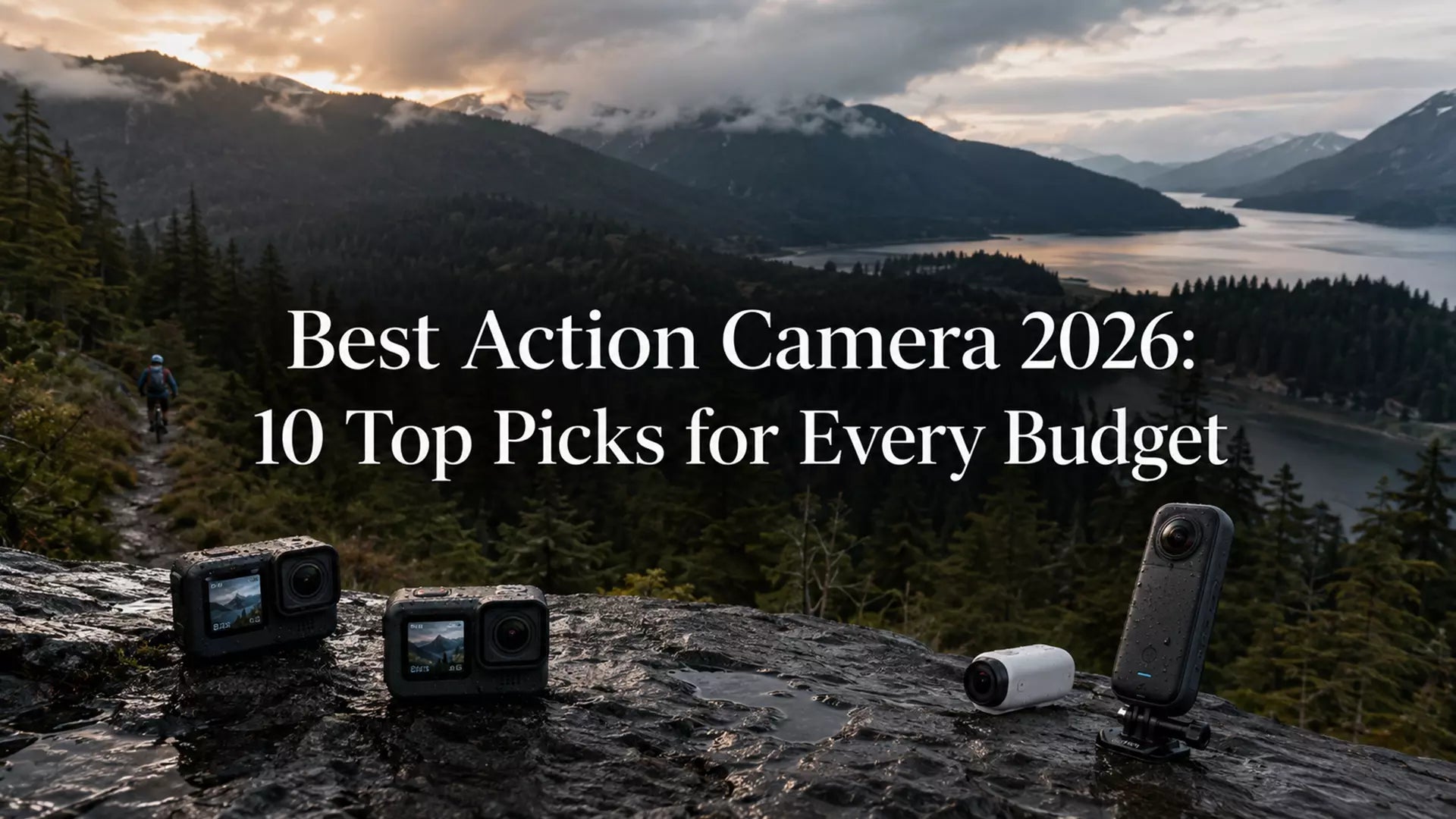
7. GoPro HERO13 Black — Best Vlogging Camera for Adventure
Not every vlog happens in a studio or on a city street.
If your content involves skiing, mountain biking, surfing, hiking or other situations where your camera is likely to get wet or knocked around, a GoPro makes considerably more sense than a delicate mirrorless setup.
The HERO13 Black offers strong electronic stabilization, rugged construction and high-resolution video in a very compact body.
Its main limitation for traditional vlogging is the fixed ultra-wide perspective. You don't get the same shallow depth of field or low-light flexibility as a larger camera.
But when durability matters more than cinematic background blur, that is a worthwhile trade.
Best for: Adventure vloggers, outdoor creators and POV shots.
8. Insta360 X5 — Best Vlogging Camera for Creative Angles
A 360 camera changes the way you think about vlogging.
Instead of deciding exactly where to point the camera while recording, the Insta360 X5 captures the surrounding scene and lets you choose the framing later.
That can be incredibly useful for travel and action content. You can record yourself walking, cycling or exploring without constantly worrying about whether you're actually in frame.
The trade-off is the editing workflow. 360 footage gives you more flexibility, but it also means one more step between recording and publishing.
If you want simple, ready-to-post footage, a normal vlogging camera is easier.
f you want unusual perspectives and more freedom during shooting, 360 is far more interesting.

9. DJI Osmo Action 6 — Best Vlogging Camera for Outdoor Creators
The DJI Osmo Action 6 sits between a conventional action camera and a creator-focused camera.
Its rugged design makes it suitable for outdoor shooting, while its larger sensor and strong stabilization make it more useful for creators than a basic action camera.
It is especially attractive if your vlog involves travel where you don't know what conditions you'll encounter.
One minute you might be filming yourself walking through a city; the next you're on a beach or hiking in the rain.
A rugged camera gives you that flexibility without needing to worry about protecting a larger mirrorless body.
Best for: travel, outdoor vlogging, hiking and action-heavy content.
10. Fujifilm X-S20 — Best Hybrid Camera for Vlogging and Photography
If you don't want a camera that is only good at vlogging, the Fujifilm X-S20 deserves consideration.
It combines an APS-C sensor with in-body stabilization and strong video capabilities while remaining relatively compact. Unlike many dedicated vlogging cameras, it is also a genuinely capable stills camera.
That makes it a particularly good option for someone whose content mixes video and photography.
For example, a travel creator might use it to record a walking tour in the morning and photograph landscapes in the afternoon.
The downside is that it doesn't have the same dedicated creator-first simplicity as the Sony ZV series or DJI Pocket line.
Best for: hybrid creators who shoot both photo and video.
Which Vlogging Camera Should You Buy?

The answer really depends on your workflow.
If you want the easiest camera to carry and use, the DJI Osmo Pocket 3 is hard to beat.
If you want interchangeable lenses and room to grow, the Sony ZV-E10 II is one of the strongest choices.
If you're looking for a compact dedicated vlogging camera, consider the Canon PowerShot V1 or Sony ZV-1 II.
For professional low-light video, the Sony ZV-E1 is the more serious option.
And if you're primarily creating outdoor or adventure content, a GoPro HERO13 Black or DJI Osmo Action 6 makes much more sense than carrying a mirrorless camera into situations where it could easily get damaged.
There is also an important distinction between a vlogging camera and a travel camera. If you want to take photos as seriously as you take video, choosing from the best compact cameras for travel photography can lead you toward a more balanced camera rather than a device designed almost entirely around video.
What Makes a Good Vlogging Camera in 2026?
The best vlogging cameras aren't necessarily the ones with the longest specification sheets.
For most creators, I'd prioritize these features in roughly this order:
1. Autofocus
If you're filming yourself, autofocus needs to be dependable. A camera that repeatedly loses your face is frustrating regardless of how good its sensor is.
2. Stabilization
For handheld vlogging, stabilization can completely change the look of your footage. A mechanically stabilized camera such as the DJI Osmo Pocket 3 has a major advantage when you're constantly moving.
3. Audio
Good video with bad audio still feels amateurish. Check whether the camera supports an external microphone or wireless microphone system if audio quality is important to your content.
4. Screen Design
A screen that faces you is one of the simplest but most useful features for solo creators.
5. Size
This one is easy to underestimate.
The best vlogging camera is useless if you constantly leave it at home because it's too large or complicated.
Final Thoughts
There is no single camera that wins every vlogging scenario in 2026.
The DJI Osmo Pocket 3 is arguably the easiest recommendation for creators who want a small, stabilized, ready-to-shoot setup. The Sony ZV-E10 II makes more sense if you're building a long-term interchangeable-lens system, while the Canon PowerShot V1 offers a compelling middle ground for creators who want a dedicated compact camera.
Meanwhile, full-frame options such as the Sony ZV-E1 are better suited to serious creators who can actually take advantage of their additional image quality.
And for adventure creators, sometimes the smartest choice isn't a traditional vlogging camera at all. A rugged action camera can be easier to carry, easier to mount and much less stressful to use outdoors.
The important thing isn't buying the camera with the most impressive specifications.
It's buying the camera that makes it easier to actually create.